AI-built product2026Live
TempoParking: a live parking directory built with AI agents
A Spanish directory of over 15,000 car parks where Claude Code writes most of the code and versioned agents rewrite the listings. My part is the contract: the rules, the checks that must prove they can fail, the spending vetoes and the calls only a person makes.
Built and operated with AI agents, under human review
- Role
- Built and run it; AI agents write most of the code
- Timeline
- 2026, live and in active development
- Stack
- Next.js 15, React 19, TypeScript, SQLite, Python, Leaflet
- AI tooling
- Claude Code (Opus 4.8, then Opus 5), Opus sub-agents; Cursor and Codex for bounded jobs
- Scale
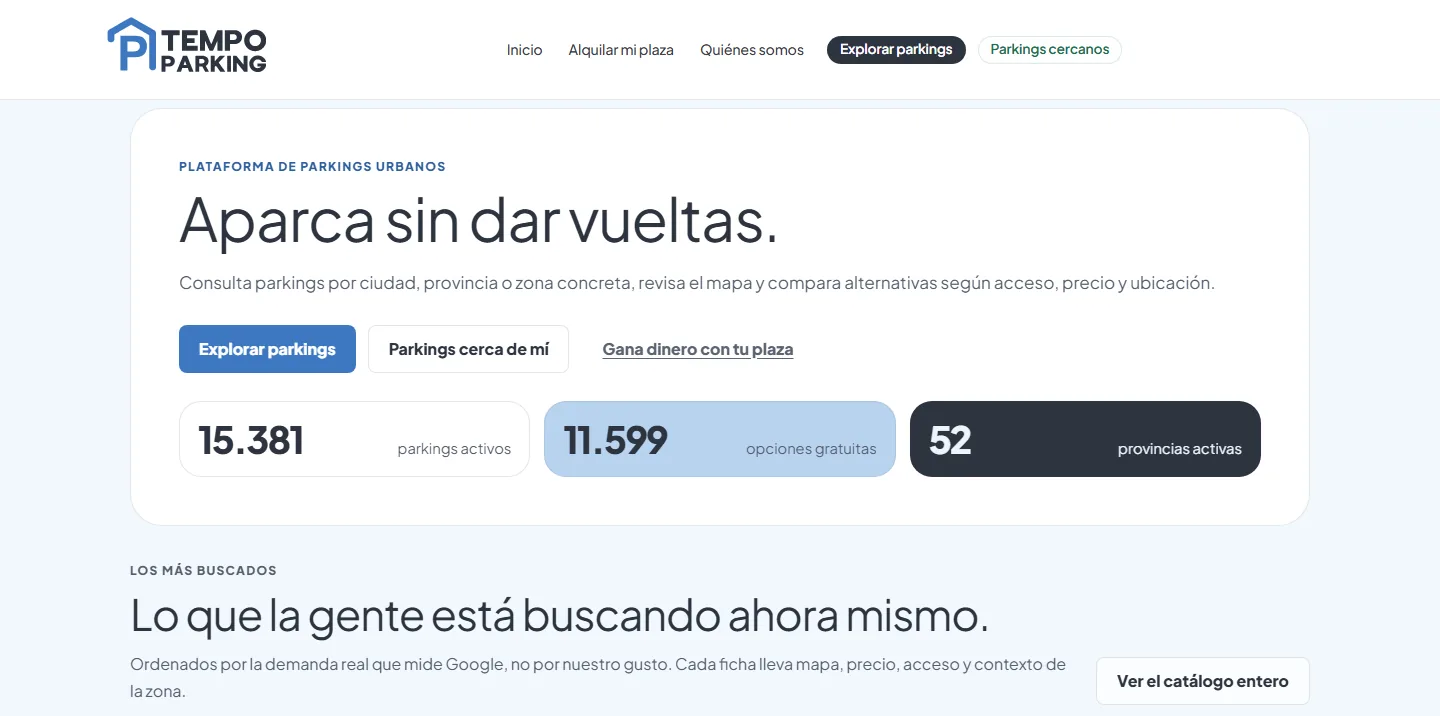
- 15,381 car parks, 1,836 landmark pages, 1,622 town pages
- Claude Code
- AI agents
- LLM evaluation
- Prompt versioning
- Data quality
- Data pipelines
- Next.js
- SQLite
- +2
- Problem
- Car-park data is scattered across operator sites, OpenStreetMap and Google, and often contradicts itself. Search only rewards pages that are specific and true.
- Approach
- Claude Code as the engineer under a written contract, versioned agents behind a deterministic lint, self-testing checks on every deploy.
- Outcome
- 15,381 car parks live in 52 provinces. Google clicks grew from 1,755 in June to 44,520 in the first 26 days of August.
- Car parks on the live site
- 15,381
- Home-page counter, 18 Sep 2026
- Google clicks, June to August
- ×25
- 1,755 → 44,520 (August: 26 days)
- Commits co-authored by Claude Code
- 803 / 830
- Working branch, to 18 Sep 2026
- Listings rewritten by versioned agents
- 3,940
- By 1 Sep 2026
Clicks: Google Search Console daily totals, read 30 Aug 2026. Commits: Co-Authored-By trailers in the git history.
Where to park near anything in Spain
TempoParking is a Spanish directory of car parks, focused on free parking and on where to park near a landmark, a beach or a venue. No bookings, no payments: it lives on search. Every car park, town and landmark is a page, and a data-quality score decides which ones get indexed.
On 31 August the site had 1,836 landmark pages, 1,622 town pages and 4,840 indexable car-park pages. In twelve days of August, AI crawlers made 162,086 requests against 41,124 human page views.
Search clicks grew 25× in two months
Clicks per month
Search clicks grew 25× in two months| Category | Google search clicks |
|---|---|
| May | 192 clicks |
| Jun | 1,755 clicks |
| Jul | 17,616 clicks |
| Aug* | 44,520 clicks |
*1–26 August only. Average position improved from 12.1 in May to 8.6 in August.
Source: Google Search Console daily totals, read 30 August 2026.
Claude Code writes the code. I write the contract
Claude Code co-authored 803 of the 830 commits on the working branch: the app, the pipeline, the audits and most of the documentation. It can reach the production server, so the rules live in files it must read before acting:
- CLAUDE.md: the hard rules, including Rule 0 below.
- A decisions log, D-001 to D-081, each with an evidence level.
- One task queue: 494 items on 18 September, 317 owned by Claude, 23 waiting for me.
- A changelog: 233 dated entries with revert steps.
- 20 workflow sheets; the deploy fails if a script appears outside them.
Cursor and Codex got bounded jobs. When Codex restyled the admin panel, Claude caught its quality badges showing green for bad scores.
Agents propose and write; irreversible calls stay with me
| Task | What the AI did | What I decided | Guardrail |
|---|---|---|---|
| Code | Features, fixes, audits, docs. | Priorities and trade-offs. | “Done” includes a green type check, no new failing guardians and the data shipped. |
| Listing rewrites | Opus sub-agents rewrite text from reviews and our own fields, and flag contradictions. | Sets the editorial rules; signs off before published titles change. | Deterministic lint, dry-run apply, version stamps. Owner-confirmed fields are locked. |
| Paid API calls | Builds the batch, estimates the calls. | Approves spending per session, cost and volume separately. | One function makes and logs every call. The live site never calls Google. |
| Bulk data changes | Writes the script, runs it dry, shows ten samples. | Reviews the sample; production waits for my go-ahead. | Dated backup, disk ceiling, archive instead of delete. |
| Questions to me | Checks the decisions log first. | Answers what the log does not cover. | Only my literal words carry my name; inferred rules stay “candidate”. |
- Task
- Code
- What the AI did
- Features, fixes, audits, docs.
- What I decided
- Priorities and trade-offs.
- Guardrail
- “Done” includes a green type check, no new failing guardians and the data shipped.
- Task
- Listing rewrites
- What the AI did
- Opus sub-agents rewrite text from reviews and our own fields, and flag contradictions.
- What I decided
- Sets the editorial rules; signs off before published titles change.
- Guardrail
- Deterministic lint, dry-run apply, version stamps. Owner-confirmed fields are locked.
- Task
- Paid API calls
- What the AI did
- Builds the batch, estimates the calls.
- What I decided
- Approves spending per session, cost and volume separately.
- Guardrail
- One function makes and logs every call. The live site never calls Google.
- Task
- Bulk data changes
- What the AI did
- Writes the script, runs it dry, shows ten samples.
- What I decided
- Reviews the sample; production waits for my go-ahead.
- Guardrail
- Dated backup, disk ceiling, archive instead of delete.
- Task
- Questions to me
- What the AI did
- Checks the decisions log first.
- What I decided
- Answers what the log does not cover.
- Guardrail
- Only my literal words carry my name; inferred rules stay “candidate”.
On 18 September, Claude Code’s own permission classifier also stopped a production write and left it for me.
What the agents may not do
- Spend on a paid API without my approval. Over 10 calls needs a second approval even when free: the monthly quota only resets on the 1st.
- Delete data. It gets archived.
- Publish copied text, or call a car park free without evidence.
- Lower the indexing threshold, or rewrite content at scale with an LLM.
- Silence a failing guardian. Skipping them is my call, with a written reason.
- Follow a rule that is not in its versioned prompt.
From scattered sources to a gated deploy
01
Sources
- Operator websites
- OpenStreetMap
- Openly licensed photos
- Google Places, enrichment only
02
Master and bridge DBs
- One record per car park
- One place ID, one listing
03
Listing agents
- Opus, batches of 5
- Prompt v6.15
- Typed flags
04
Deterministic lint
- auto · review · blocked
05
Apply and rescore
- Dry run by default
- Version stamp
- Score of 60+ gets indexed
06
Deploy gate
- 58 guardians
- 50 break-on-purpose runs
- Canary first
As of 18 September 2026. The score decides indexing, never what users see.
Each prompt version has to earn its number
Every change to an agent’s rules bumps its version, stamped on each listing it writes: 3,940 listings and 5,997 revisions by 1 September. Each version states in advance how it will be judged, and the judge changed as I learned.
The quality score rewarded invention: “hours and price not confirmed” scored 93, an invented “200 m from the cathedral, open 24 h, free” scored 96. Versions are now judged by errors corrected minus true facts dropped. Since v4.0, a feature taken from reviews needs a word-for-word quote; 21 of the first 84 were paraphrases and were rejected.
I picked the model by measuring it: Opus looked harder
Same prompt, same saved inputs, three models, 30 listings across three agents. Nothing was written to any database.
| Measure | Haiku 4.5 | Sonnet 5 | Opus 5 |
|---|---|---|---|
| Prepared findings caught | 6 / 9 | 9 / 9 | 9 / 9 |
| Contradictions flagged unprompted | 14 | 11 | 27 |
| Published errors corrected | 0 | 12 | 21 |
| Descriptions too short (of 10) | 6 | 0 | 0 |
| Titles changed (of 10) | 7 | 2 | 1 |
| Published a wrong city | Yes | No | No |
24 July 2026. No model hallucinated; the hallucination detector raised four false alarms. Opus needed fewer turns and about half the output, so it cost no more per listing than Sonnet. All listing agents moved to Opus.
Every check has to prove it can fail
A guardian blocks a deploy when an invariant breaks. Each one ships with a perturbation mode that breaks the protected thing on purpose and confirms the guardian turns red: mutation testing, aimed at the detectors.
Running them was the hard part. On 30 August, 50 of 75 guardians ran nowhere and none ran in CI. Deploys took over two hours, although only 3 of 18 failures in 30 days were real defects. Now CI runs 15 guardians on every branch, deploys gate on 58 plus 50 perturbation runs, all of them run each morning (301 on 13 September), and new failures reach the first message of each Claude session.

Rule 0: fix a defect where it is born, not where it is seen
Written on 9 September, after 2,339 listings had been reviewed on more than one day because nobody closed the flag. A wrong listing is a sample of a mechanism.
01
Measure the mechanism, not the example
What else passes through this function, column or table?
3,016 listings shared one wrong chip.
02
Fix what is already published
Chips regenerate; written prose must be rewritten.
03
Find the origin, with file and line
Ingestion, template, agent, script or brief.
460 duplicate reviews came from two ingestion paths.
04
Close the door
Constraints and validation, so bad data cannot return.
One database trigger instead of eight patches.
05
Leave a guardian that can fail
And ask why an existing one stayed green.
One passed for a week reading empty folders.
06
Close the flag and check production
Then write the lesson next to the failing line, with its number.
I tested my own knowledge base. It changed nothing
The project keeps about 7,400 short lessons and a search tool over them. I built a test bench to see whether the tool helped debugging agents: the same tasks with and without it, graded against written answers, over four rounds and 16 tasks with Sonnet 5 and Opus 5.
It changed zero answers and saved no more tokens than the control group; 96% of the lessons came from files the agents could already grep. Only a researched expert brief changed results, at 21–40% more tokens. Agents asked once, in two to six words, so the tool now splits each question into seven searches itself.
Most rules have an incident behind them
26 Jun
An uncapped Google sync
Paid batches are now estimated, approved and logged.
8 Jul
A host-side rebuild overwrote production
Deploys now stop if the host rebuilt on its own.
30 Jul
A paid area listed as free for 25 days
Its owner caught it. Five of six failures were in the code around the agent, not the prompt.
3–15 Aug
Six dev servers, then eight agents at once
The first crashed the Claude app at 97% RAM. Both now have a cap of three, written in CLAUDE.md.
12 Aug
A batch applied straight to production
216 listings of work lost. Workflows now write to the bridge first.
30 Aug
Five self-audits
Among the findings: a Next.js advisory (CVSS 9.5) missed for five days, since patched.
What holds, and what is still open
Holding up
- Model choice by measurement.
- Paid calls behind approval and a per-call log.
- Deploys gated by self-testing guardians.
Still open
- No proof that newer agent versions rank better: three analyses disagreed on the sign because the queue was ordered by traffic. The next campaign needs a control group reserved up front.
- Flagging is not fixing: on 2 September, 96.5% of 9,020 agent flags were pending; on 15 September, 15,384 of 22,044 were open.
- Accuracy debt: 183 listings showed an airport price from Faro, Portugal (fixed in the bridge on 18 September, not yet live); 397 place IDs were shared by 879 listings (31 August).
- Thin data: the median listing has one of nine own data fields (30 August).
- Seasonality: demand for “dónde aparcar” fell 39% from mid-August to early September.
Next case study
Moduly Homes: an AI-built catalog that has to prove its numbers
Related

Web product2026Live
Moduly Homes
A live comparator of 1,137 prefab home models, with a source for every figure.
modulyhomes.comAI engineering
Teaching a debugging agent where to look first
An AI agent for parasitic-extraction debugging, built without a vector database: gated phases, hybrid lexical search, benchmarks and intent-routed playbooks.
Backtest realism
The backtest that lies, and the rules that stop it
The rules that keep short-horizon backtests honest: stop, take-profit, entry inside every bar, reaction latency, slippage, and payout and leakage audits.
Get in touch
Working on something similar? I am happy to compare notes.